Showing posts with label Wildlife. Show all posts

Thursday, June 30, 2016

Deer Trends -- A tribute to a deer I once knew

Well, you're not shy, are you?
Life in the forest lasts for thousands of years for the sugi (Cryptomeria) trees,
but, alas, on this scale, the animals are fleeing transients, glimpsing only a few years, a single tick on the astronomical clock before their time is gone. They cannot know the dark past of logging, as even we can only imagine the forest before the axe was set upon the massive trees. Who knows how many deer thrived on the island back then, with man as their only predator!

Let's briefly go back to the beginning. Yakushima was connected to mainland Japan during the last ice age, say around 10,000 years ago, and both people and deer, but no wolves or bears came to Yakushima. Then, 7,300 years ago the Kikai Caldera, a volcanic group halfway between Yakushima and Kagoshima blew up and coated Japan in ash, killing just about everything in southern Kyushu. In Yakushima, only a small part of the island in the south remained unburied, allowing a handful of deer and monkeys to survive to repopulate the island. Before long, people were also back.

Fast forward to modern times. Full-fledged logging began in Edo times, and in the 19th century, the deer hunting season was set to coincide with fall and winter, when the bucks have a full set of antlers. Although measures to protect old growth trees were taken during Meiji times, logging flourished, especially during wars, reaching a peak in the mid-20th century days of post-war reconstruction. Loggers often wore a patch of deer fun at their waist, which they could use to wipe their hands or sit on, but the deer population dropped from an estimated 10,000 to 20,000 head pryer to 1950 to 2~3,000 head in the 1960s. For a period of seven years in the 1970s, hunting was banned, and as logging then slowed to an end, new growth started filling in the swaths of clear-cut land. Consequently, the deer population boomed once more, growing at a rate near 20% each year in the 21st century and approaching 20,000 head.

When I started guiding, you could hardly call a hike complete without spotting several deer, and come spring, the bellies of female deer bulged with pregnancy. Out of over 200 hikes to Jomon Sugi, only once did I go without spotting a deer. Until the summer of last year, 2015, when, inexplicably, deer along the trail started to die. At first, we attributed the carcass stench to the season: Many deer are born in early July, and it's only natural for a few pregnancies to fail. But as summer wore on, I kept a mental list of places where I needed to distract guests with weaker stomachs. Come winter, deer-less hikes to Jomon Sugi and around Shiratani Unsuikyo became quite common. Guests would ask, Where do the deer go in the winter? And I no longer had a good answer. Where were they? Dead?

I think all the guides who regularly hike to Jomon breathed a sigh of relief when deer started reappearing in the spring, and I spotted some familiar deer faces that I hadn't seen since the previous year, but deer-less hikes are still eerily common, and the annual spectacle of pregnancies and births and newborn deer is nothing like in previous years. Some folks say they've seen newborns along the Jomon trail this year. . . I'm not sure I believe them.

What I do know is that on June 16 or 17, another old acquaintance passed; I believe he was the one I depicted in a postcard last year. With that full set of antlers, he could not have been young, so perhaps it was just his time.

I haven't heard anything about disease, and some studies have concluded that populations of Japanese (sika) deer are self-regulated by factors like disease and food pressure, and I think it's quite possible that we've finally reached a peak in the population. Also, the central mountains and the West Forest are still chock-full of deer, so I suppose it's nothing to worry about. Still, it's a bit lonely to hike to Jomon Sugi without always seeing several familiar deer along the trail. And I do wonder how the population will change in years to come.

Anyways, I've learned to be grateful for each deer encounter, and to feel respect for each animal.


Sources include:

Tsujino, R. Population dynamics of sika deer. 奈良教育大学自然環境教育センター紀要, 15:15-26(2014)
http://near.nara-edu.ac.jp/bitstream/10105/9884/1/NEE15_15-26.pdf

揚妻直樹生物. シカの異常増加を考える. 生物科学(2013)65(2):108-116
http://eprints.lib.hokudai.ac.jp/dspace/bitstream/2115/54808/1/65_2_108_116.pdf
and
Naoki Agetsuma : Are deer populations increasing UNNATURALLY?
http://forest.fsc.hokudai.ac.jp/member/Agetsuma/%E3%83%AA%E3%83%BC%E3%83%87%E3%82%A3%E3%83%B3%E3%82%B0HP%E7%94%A8E.pdf


Saturday, May 9, 2015

Snakes in Yakushima

Snakes! Well, let me start by saying, I like snakes. Mostly visible in the summer months, you can often find them sunning themselves on dry days. Fortunately, you don't have to worry about the infamous Habu snakes of Okinawa, but Yakushima does have a bunch of other species, including poisonous snakes like the Japanese pit viper, called the mamushi. Here are some of the snakes that I've come across.


Mamushi

This is the Japanese pit-viper found throughout the country and other parts of east Asia. The venom contains both hemolytic and neuro-toxins. Fortunately, these snakes tend to stick to the shadows and be more active around nightfall, but every once in a while I come across a young one sunbathing in the early summer or on dark, overcast days. I've never spotted them around the mountain huts or at elevations over 900 meters, and I've never heard of anyone getting bit in Yakushima, but this is the one snake you be aware of. Thankfully, they are relatively easy to recognize by their triangular heads, black eye-mask, and overall pudginess.


Tiger Keelback (Yamakagashi)

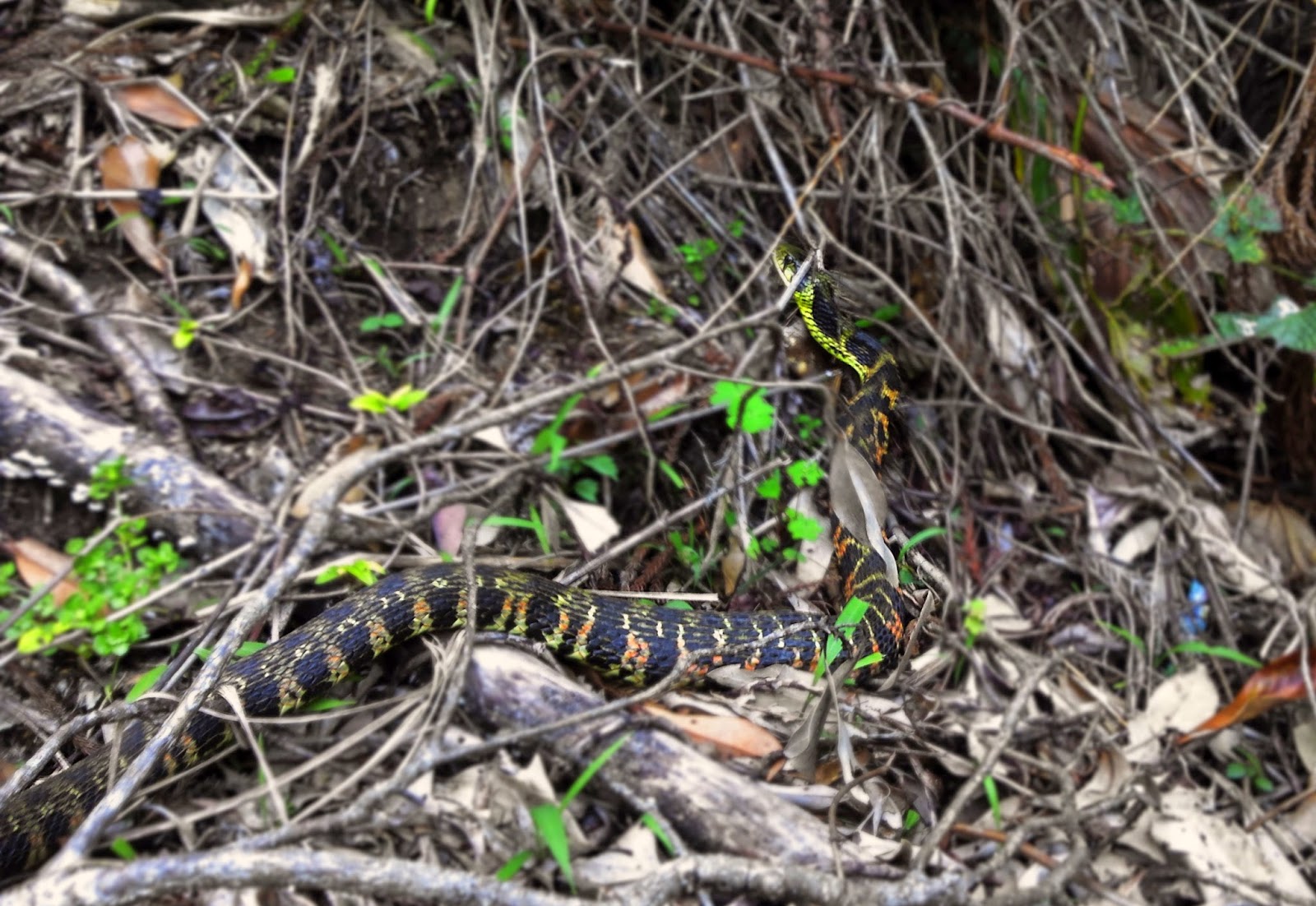
This beautiful snake is also poisonous, but most sources agree that you don't have to worry much about them. The fangs, located in the back of the mouth, are good for subduing prey, but not very effective for defense. Back in 2017, a child was bitten in Hyogo prefecture and temporarily lost consciousness, but, on the other hand, I have an acquaintance who was bitten when he accidentally grabbed one, but received no poison! Would-be predators know better than to attack the tiger keelback because, when threatened, glands on the back of its neck swell up to release the toxins it sequesters from eating Japanese common toads. I often spot this one sunning itself.


Burrowing/Forest Rat Snake (Jimuguri)

These are not known to be dangerous, but the juveniles have a coloration similar to the tiger keelback and I've had one take a defensive, striking stance as it backed away from me. The adults are much more drab, but the young ones are often spotted in the spring. The Japanese name reflects their use of rodent burrows.


Japanese Rat Snake (Aodaisho)


This common snake tends to freak people out because they can grow to be a couple meters long and they aren't exactly shy. Excellent hunters, they are revered by farmers for keeping rodent populations in check. They can be spotted both in the mountains and in fields outside of town. The juveniles have a coloration similar to mamushi.


Japanese Four-Lined Ratsnake (Shimahebi)


The majority of these guys that I've seen were victims of traffic encounters, but apparently they're pretty common. Most of the ones I've seen are the blackish variety, but they can be pale grayish with dark lengthwise bands that sometimes tend towards spots.

Asian/Japanese Keelback (Hibakari)


What can I say besides this is one cute little snake! When startled, they often take an aggressive posture, raising their heads as if readying to strike. They appear so intimidating that supposedly people used to think they were poisonous, giving them the Japanese name, Hibakari, or "merely a day", as in, "merely a day left to live if you are bitten." But, in fact, they are quite harmless, and if you look closely, they look like they're readying for a kiss! I spot lots of these guys in early summer.


Erabu Sea Snake (Erabu Umi Hebi)

You might see these beautiful, graceful snakes if you go snorkeling or swimming in rocky areas. I admit I worry about stepping on them when wading in rocky areas. Thank goodness they're docile because sea snakes apparently have some of the most deadly venom in the world! I spot them most often in June and July, but that may be because that's when I'm swimming! Anyways, enjoy their beauty if you do spot one.


Most of these snakes enjoy sunny weather as much as tourists, and there are several more non-poisonous species in Yakushima that I haven't mentioned. So be on the lookout this summer and maybe you'll be lucky enough to spot one!

Thursday, April 9, 2015

Common Birds in the Mountains

I'm often asked why we don't see more birds along the trail. There's quite a few song birds in the forest, but they are small and the brush is thick! In fact, I usually don't point them out to my guests unless they are particularly visible or we have plenty of time to spare. Sometimes, I'll even wager a can of coffee that you can't spot the bush warbler, who often sounds so close, but hides quite well.

Here are some birds that are often seen, or rather heard, along the mountain trails. If you're lucky, you may spot others, such as a woodcock, owl, or ashy minivet. In the coastal plains and around town, you can see other birds, including pheasants, blue rock thrushes, and wagtails; and of course, there are many waterfowl near the coast and the mouths of rivers.

Varied Tit, Parus varius (yamgara)
Often comes in small flocks of friendly birds. They have both a horse, jay-like caw and a sweeter chikapi~, chikapi~ voice.


Coal Tit, Periparus ater (higara)
Smaller than the varied tit and grey.
Often in flocks that sometimes mix with other species such as varied tits.

 Brown-eared bulbul, Hypsipetes amaurotis (hiyodori)
Pretty common at low altitudes and near the edge of town. Beautiful birds, but really obnoxious cries.


Eurasian Jay, Garrulus glandarius (kakesu)
Especially good at mimicking other birds and remixing "new" tunes, but the usual cry belies its relatives, the crows.

Japanese White-Eye, Zosterops japonicus (mejiro)
Sweet chatter that once created a market for these birds as pets. They are visible looking for flowers year-round, and are especially visible in winter, when flocks from colder areas also visit Yakushima, and when the camellias and sakura trees bloom.

Japanese Bush Warbler, Horornis diphone (uguisu)
With its characteristic, "ho---kokekyo!" call, this bird symbolizes rural Japan as much as any, but it is notoriously hard to spot in thick brush.


Eurasion Wren, Troglodytes troglodytes (misosazai)
Small bird with a big voice, heard in spring through late summer. The males will stand atop a branch, point their tail-feathers straight up, and open their mouths wide to sing.


Japanese Robin, Erithacus akahige, (komadori)
I once had a client who kept mistaking this bird for her cell phone. The female is a more drab brown. I often see them in pairs, with the male following the female and calling to her.


Daurian Redstart, Phoenicurus auroreus, (joubitaki)
(male)  
These birds winter in Yakushima. I can't explain why the males seem to be more visible in the mountains while the females are more prominent in around town.
Daurian Redstart, Phoenicurus auroreus, (joubitaki)
(female)

Japanese Green Woodpecker, Picus awokera (aogera)

Large, easily identifiable bird. If you hear a prolonged knocking, it may be either this bird, or the much smaller black-and-white pygmy woodpecker.
Pale Thrush, Turdus pallidus (shirohara)
This bird winters in Yakushima. It makes a sound that reminds me of wet flip-flops as it leaps down the street; quite startling when you're driving.

Brown Dipper, Cinclus pallasii (kawagarasu)
Often seen in solitary on rocks in the river.
Narcissus Flycatcher, Ficedula narcissina (kibitaki)


 Whistling Green Pigeon, Treron formosae, (zuaka-aobato)
A shy bird, but the call like a siren or flute is unmistakable.


Japanese Wood Pigeon, Columba janthina (karasubato)
Even shier than the whistling green pigeon, this bird has a very deep, owl-like hoot. It is a registered national treasure.


Swallows
(tsubame)

Pacific swallows seem to be pretty common, but especially when glanced from afar, I wouldn't put my money on naming swifts and swallows. Come spring, flocks swoop overhead or through town and often build nests in carports. To my untrained ears, the voices sounds similar to an ashy minivet, which is another bird you don't often get to see close up.

Wagtails
(sekirei)
Yellow, grey, and black-and-white: Wagtails are especially visible in open spaces at low elevations during colder months. But yellow ones [officially called Grey Wagtails] like this one can also be seen flitting down the trail among the central mountains.
 
Black Kites
(tobi or tonbi)

These birds are a common but lovely site above the coasts. Where I grew up, we have lots of sea gulls and terns, but in Japan, black kites dominate. While they're not really forest birds, if you're hiking in the outer mountains, you may spot them overhead.