Showing posts with label Activities. Show all posts

Wednesday, May 31, 2017

Canopy Walk and Tree-House Cafe

If anything can bring out your inner-child like a walk in the Moss Forest full of babbling brooks and curious deer, it's got to be this DIY super-project: The Canopy Walk and Tree-House Cafe near Senpiro Waterfall.

Alright, before we go any further, if you can't handle a few six-legged friends, or if you're looking for Disney-style luxury and high-tech safety features, or if you expect to be repelling/belaying/bouldering, you're probably not ready for "Wild Level 1," let alone "Wild Level 5," which is Canopy-talk for, "Please proceed with caution."
Seriously.
While first-graders and up are welcome (If you have kids, bring them here!) everyone gets a belt with a clip that you are instructed to keep hooked on to the ropes at all times. Now if your ego is too much too wear a safety belt in the kids' house, you need to check that adult attitude in the parking lot. So, yes, , , ,


you will make wishes when you play ring toss. . .

you will proclaim the love of your life (Hope you brought your significant other as well as the kids!) to the mountains, , ,

, and for every step you take up into the tree tops, you'll peel back another year towards childhood!

The owner, in addition to speaking Japanese, Chinese, and English, is always coming up with new ideas and adding subtle surprises to the tree-walk, the parking lot, even the rest rooms!

The best addition is the Tree-House Cafe. This is a tree-house you rent out for the cost of a cup of coffee or juice (nothing fancy, but it's not really about the coffee). Call ahead to make a reservation, because there is only enough space for one party of conspirators in this tree-top hide-out.


Canopy Walk
Location: Haru 677-44 (30.24918, 130.57296) Southwest of Senpiro Waterfall.
Hours: 9am/10am~4pm/5pm depending on the day.*
Price: Around ¥1000 for adults, less for students, more if you do the "Canopy Rope" and ¥500 for the cafe.
Website: http://canopywalk.web.fc2.com/

Sunday, July 12, 2015

Craft your own Yakusugi Chopsticks

These days, it's hard to find a restaurant that does not use disposable chopsticks, but how making a pair that could outlast you? It's the perfect Japanese gift with a personal touch, it doesn't require a lot of time and money, and there are several studios around the island set up for guests to make chopsticks. Crafting a set of chopsticks will also give you a bit of incite into the properties of the Yakusugi wood. Oh, and you can do it even in bad weather.

Of course, if you don't have time to make your own, you can always buy a set. either way, you'll probably want to keep in mind two things:

1. Practicality
Yakusugi wood (and Japanese cedar wood, in general) is not hard like ebony, but rather flexible, and the chopsticks should be quite strong and durable so long as the grain runs the length of the stick. In fact, Sugi no Ya displays unusual chopsticks that have been purposely crafted to match the curve of the wood, each chopstick fitting perfectly against its partner. Because a craftsman's hands will tend to naturally follow the grain of wood, hand-crafted chopsticksweather straight or curvedare more valuable than bulk-machined chopsticks. It probably goes without saying that, although burly wood with gnarled, twisted grain is highly prized in artistic pie

Chopsticks of varying prices.
The set on the left has the
most expensive price tag.
2. Aesthetics
Yakusugi is known for very fine grain, and basic chopsticks are priced according to how well they show off this grain. For chopsticks with a square cross-section, finely grained wood can be cut at an angle so that the grain is visible on all four sides of the stick. Some people also favor wood that is ripply or dark with oil, or otherwise unique.

This spring, I watched two chopstick-crafting sessions, one at Takeda Sangyou, and one conducted by Mr. Sennin of Sugi no Ya. The methodology and final products could not have been more different.

Takeda Sangyou
At Takeda Sangyou, participants start with two perfectly-cut blocks of wood with beautifully fine, straight grain. Three grades of sandpaper are used to shape and polish the blocks into chopsticks that look just like the ones sold in the gift shop. This is a task that doesn't require more physical prowess, and there's not a whole lot that can go wrong. The chopsticks are then dipped in fixative, blow dried, and packaged, just like the ones in the store. If you like neatness and precision and you want a gift that is easily appreciated, or you're afraid of a chisel, I recommend Takeda Sangyou.

**Update: Takeda Sangyou has replaced chopstick-making with hand-polishing of premium pieces of Yakusugi wood, so that you take something home that is more like a gemstone than a stick. You can still see the factory, but the polishing is done in the relaxed setting of an indoor annex.

**Update: I plan to upload information on the Higashigawa workshop near Anbo soon.


Sennin-San
Participants in Mr. Sennin's workshop start with two blocks that have been hand-split. The grain may not be fine nor perfectly straight, but each set possesses a bit of individuality. Participants use a chisel--which takes a bit more finesse than sandpaper--to shape the chopsticks, and then buff the completed set with a brush-like tool made of reeds. If you're a fan of the "wabisabi" aesthetic or you want a bit more of a challenge, I recommend Mr. Sennin.


Caring for your chopsticks:
Care depends on how the chopsticks are finished. For example, because Yakusugi oil does not solidify, chopsticks that have not been fixed will need to be oiled every so often, so ask when you make or buy chopsticks.


There are several places around the island where you can make chopsticks. Most prefer that you call a day or more in advance and make a reservation.

Takeda Sangyou (武田産業)
Website: https://www.yakusugi-takeda.com/?mode=f4
Price: 2700+ yen depending on the wood
Time: Unlimited during business hours, reservation not required.
Location: Takeda Sangyou, Anbo 650-18 (30.3225,130.6569)


Sennin-san (仙人さん, workshops at two locations)
Website: http://suginoyas.com/hashi.html
Price: 1100 yen
Time: 40~50min.
Location: Senin Mura, Mianoura 2567-2 (30.4109,130.56752)
Session Times: 9:00am or 2:30pm
Location: Sugi no Ya, next to the airport (30.3822,130.6594)
Session Times: 10:30am, 1:30pm, or 16:00pm

*Times and prices subject to change. Please inquire at each location to make a reservation.

Friday, July 10, 2015

Mother-of-Pearl Accesories from WaRaku--and you can make one yourself, too!

Dr. Tagami said he spent
about two weeks on this
piece. Incredible!
The word Yakushima has been written with many different characters over the years; one of these "spellings" is 夜光島, with the characters for yakougai, the green turban shell known as a source of exquisite mother-of-pearl. I first ran across these characters shortly after arriving on the island, and I henceforth assumed that Yakushima had a long tradition of shell crafts. My assumption was further bolstered by an exhibit of finely carved mother-of-pearl figurines at last year's cultural festival. So the other day when I passed small flyer for carved mother-of-pearl accessories and a try-it-yourself workshop offered I decided to stop by and find out what this was all about. My assumptions, it turned out, were completely wrong. Mother-of-pearl crafting is just getting started in Yakushima!

Hard to forget seeing
something like this!
The address on the flyer was for Minshuku Waraku, (A minshuku is like a private inn, or a bed&breakfast, or a spare room that the owner rents out to guests.) which is just behind the new roast-beef lunch stand in Anbo. Waraku is a bit unusual because in addition to the owner's family and visiting guests, it also houses the owner's medical practice. Dr.  Tagami, it turns out, is a professional bone-setter.

Anyways, only when I pulled up to Waraku did I realize that the accommodation, the medical practice, and the mother-of-pearl accessories that I'd spotted in select  gift shops had anything to do with each other. After Dr. Tagami beckoned me out of the rain and into the foyer, I immediately spotted the figurines and carved shells from last year's cultural festival on the counter.
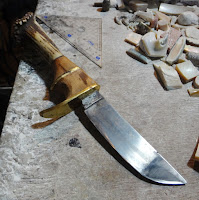
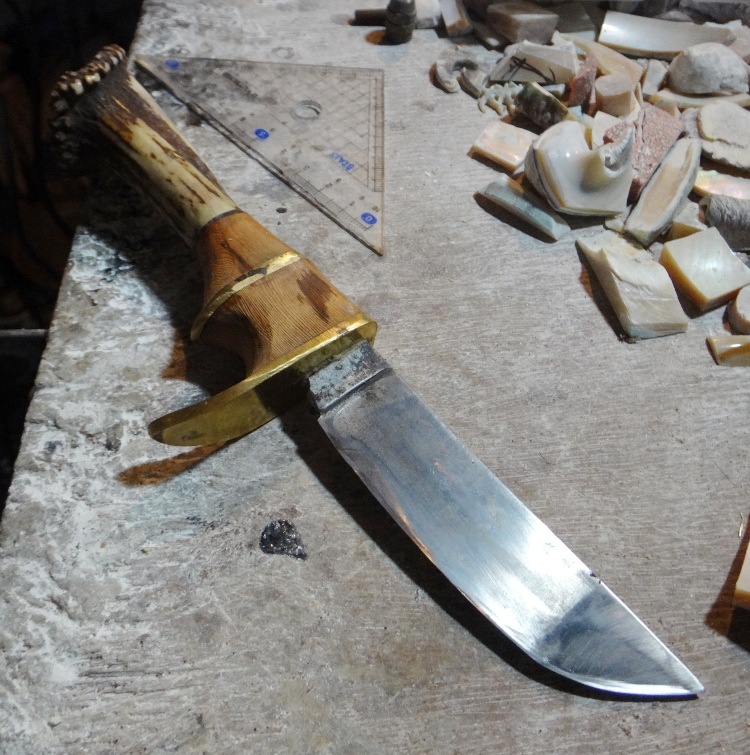
A hunting knife with a handle
fashioned from Yakusugi wood
and a Yakushika deer antler.
"Wait, are you the one who made these pieces?" I asked. I did a double-take when he said one of them would have taken about two weeks of spare time. I had assumed it would have taken years. He also explained that there really aren't many folks working with mother-of-pearl on the island. He was pretty much alone when he started dabbling in mother-of-pearl six or seven years ago. After his first piece, Dr. Tagami himself just kept receiving more large green turban shells and requests for various pieces, and so he just developed from there. What about the 夜光島 characters? It seems that there was a time when Yakushima was a major source of green turban shells for the Kinki region.


What about the tools? Do you need special tools for carving things like this?

He says the equipment is a lot like a dentist's drills, just less expensive. Would I like to see? He invites me to walk either through the doctor's office or around the veranda to his little workshop.

Clients often bring materials
available to them.
The workshop is chock-full of turban shells, abalone shells, coral, deer antlers and skulls, fragments of quartz and pieces of Yakusugi. There's an anvil and a DIY forge blocking the entrance, large fans, and sets of drills and bits and grinders and polishers, but indeed, nothing too high-tech. In fact, a pretty descent setup for mother-of-pearl work can be put together for under 50000 yen, he says. He explains that he's been experimenting with syntheses of different materials available in Yakushima and hopes to produce truly original goods.

His work is presently available in two shops: Honu (in Mugyo), and also in Hirauchi. (Oh dear, the name of the place has slipped my mind. I'll post it soon!) But he likes to take special requests, and he's excited when people come in to learn how to do it themselves.

I have to admit, I would never
have guessed he's a doctor,
until he started working!
Perfect. Because this is rainy season, and, believe it or not, I don't like hiking in the rain for days on end. Usually, he suggests that folks plan to spend several hours and go home with three pieces: First, he shows them how it's done from start-to-finish by creating a piece as they watch. (It's kind of hard to talk when you're working with the fan on.) Second, he cuts out a piece, and lets the client polish it. Third, the client creates a piece on their own.

He offers to show me and asks what shape I would like. Uh. . . how about a star? He searches around for an appropriate piece of shell and turns the fan on. Then the magic starts. He works quickly and methodically, exchanging drill bits and drills and polishers, and proving that the chaotic-looking workshop is in fact highly ordered. His hands do not shake or falter as his fingers work right next to the cutting edge. A few minutes later he has produced a highly polished star. 
Accessories made by Dr. Tagami. He made the star while I watched.

A simple piece like this, he explains, might sell for 500 yen in a shop, but he can't give a set price or time frame for clients without knowing what sort of pieces they hope to make. It's obvious he's not in this for the money, though. Anyways, the workshop is small, so only one person can work at a time, and he recommends that no more than two folks visit together.

Reservations are not necessary, but it's a good idea, because, of course, he has his other business, too. ^^

I was amazed by the precision and speed with which Dr. Tagami worked, and I'm excited to think up my own idea and try my own hand. Two words: DIY and creativity. Mother-of-pearl craft may not have a long history in Yakushima, but perhaps the tradition is just getting started.

Yakushima Minshuku WaRaku (屋久島民宿和楽)
Location: Anbo 739-146 (30.3262,130.6575)

Website: http://yakushimawaraku.web.fc2.com/yakushimazaiku.html


Saturday, June 13, 2015

Cycling in Yakushima

Just like hiking, there are many options for cyclists visiting Yakushima. There are several places you can rent bicycles round the island and if you do a little homework, you'll surely find a ride that fits your style.

Cycling Activities:
From simple transportation between your accommodation and the store, to watching the sunset and the see turtles lay their eggs after the buses have stopped running, to blissful rides through the forest, bicycling is a popular (although exhausting with all these hills!) means of getting around, but for those seeking more, here are a few suggestions:


The West Forest Road (Seiburindou)
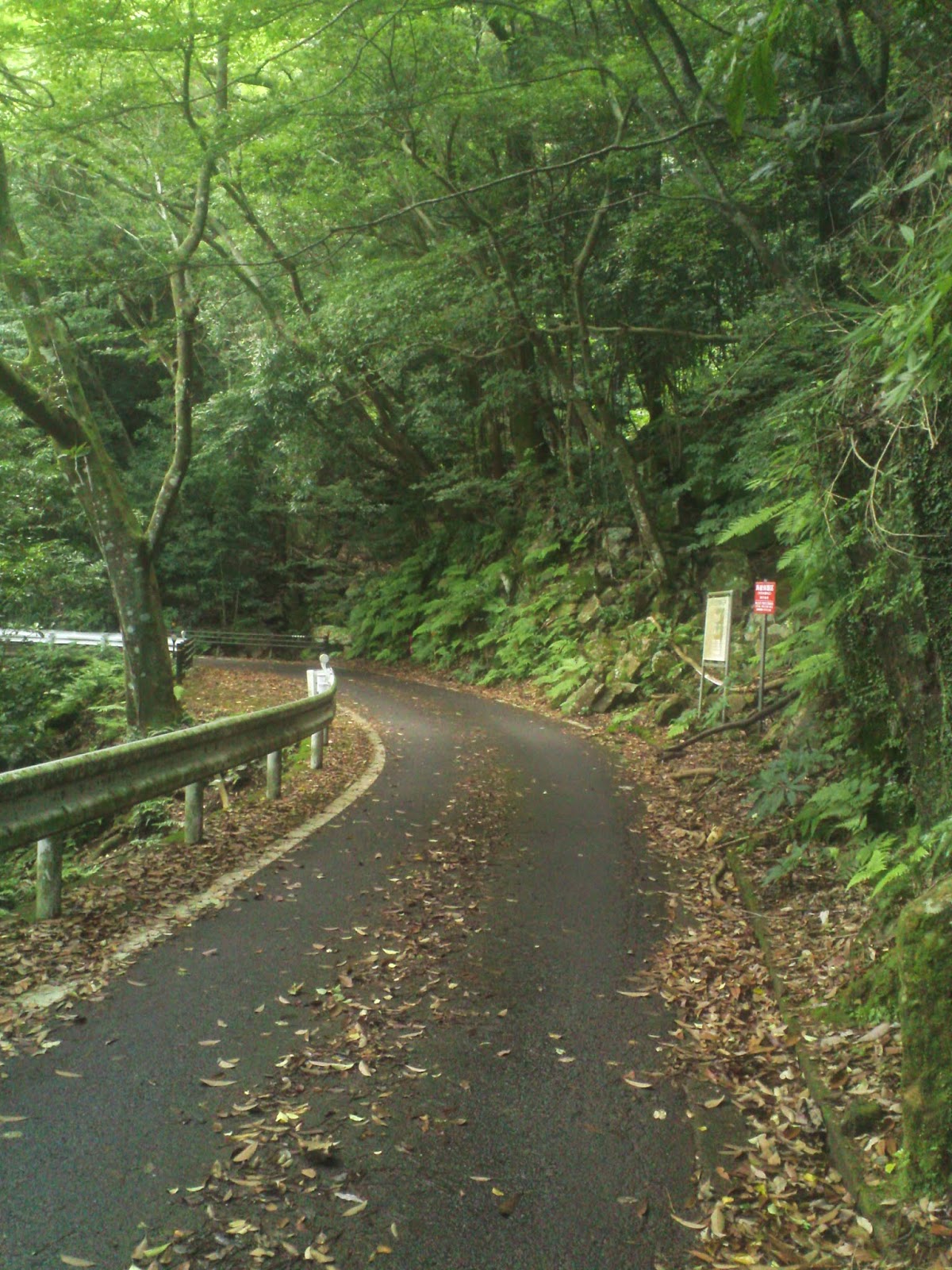
On the West side of Yakushima, the road narrows and winds right through the World Natural Heritage Site. (Yes, Yakushima is one of the few places you can drive or cycle through a World Natural Heritage Site.) Cars and tour buses can also use the road, but traffic is less than in other parts of the island and drivers are careful because the road is very windy and this area is particularly famous for deer and monkeys. Large troops forage, frolic, and relax along the road and in the surrounding forests. The road climbs up to an elevation of about 300m, but even if you have to get off your bike and walk part way, most people agree: It's worth it. In fact, you'll want to jump off your bike regularly to watch the animals. But please, do not feed them, antagonize or intimidate them, and don't leave your lunch unattended! (And avoid eye contact with the monkeys.) No matter how docile they may appear, they are wild animals, so please watch for defensive/aggressive behavior and back off if you need to.

I suggest packing a bento lunch, rain gear or sunscreen, water, and a portable-toilet pack, then taking a bus to Nagata where you can pick up a rental cycle. (You'll want to place a reservation to make sure one is available.) UFORTUNATELY RENTAL SERVICES NEARBY HAVE BEEN CUT IN 2016.Shortly after departing Nagata, stop at the lighthouse, and then continue climbing up the hilly road at a leisurely pace, stopping wherever you like. Eventually, you'll hit the road's highest elevation and begin a long descent. Be careful not to let your bicycle get away from you; pump the breaks gently to keep them from overheating and failing. After you cross the Segire River and leave the World Natural Heritage Site, you'll come to Oko Waterfall, where you can use the rest room as well as relax in the cool mist of the powerful falls that gained Oko status as one of Japan's Top-100 Waterfalls. You can return your bicycle at the shop in Kurio, or continue on.


Bicycle Tours*
Cameron, the friendly hiking guide over at Yakushima Experience offers bicycle tours. He'll pick you up with rental cycles and take you on a tour of the western side of the island (including the West Forest Road) ranging anywhere from 25 to 50 kilometers and from three to seven hours depending on your tastes, although he emphasizes a leisurely pace with plenty of photo opportunities and wildlife viewing. Staff will meet you on the other side to take you back with the option of stopping by a hot spring. Prices range from 12500 yen per person for groups of four or more to 17000 for solo riders.


Annual Cycling Event*
Enjoy aid stations, police support, photo opportunities, point-of-interest stops and more as local volunteers cheer for you and hundreds of other cyclists making their way around the 100km parameter of the island. Half (50km) and family (20km) course lengths are also offered, but this is not a timed raced. Rental cycles may be booked out, so reserve your space as well as  a bicycle (and a helmet!) or bring your own. In 2015 participation fees ranged from 3,000 yen for the short course to 9,500 yen for the full course, and applications were due the month before the event. The Cycling Yakushima event is held annually in February, so check the calendar!


Challenge Routes
The main road that wraps around Yakushima is just over 100km around and climbs up to an elevation of about 300m. If you're looking for a crazy (as in, maybe you want to see hour far you can go until you drop dead) challenge you can cycle up to the trail head at Shiratani Unsuikyo Park (650m el.) or Yodogawa (1365m el.). Please note that cyclists and pedestrians are not allowed on the turnoff leading to the Arakawa Trail Head for Jomon Sugi from March through November.


Renting a Bicycle*
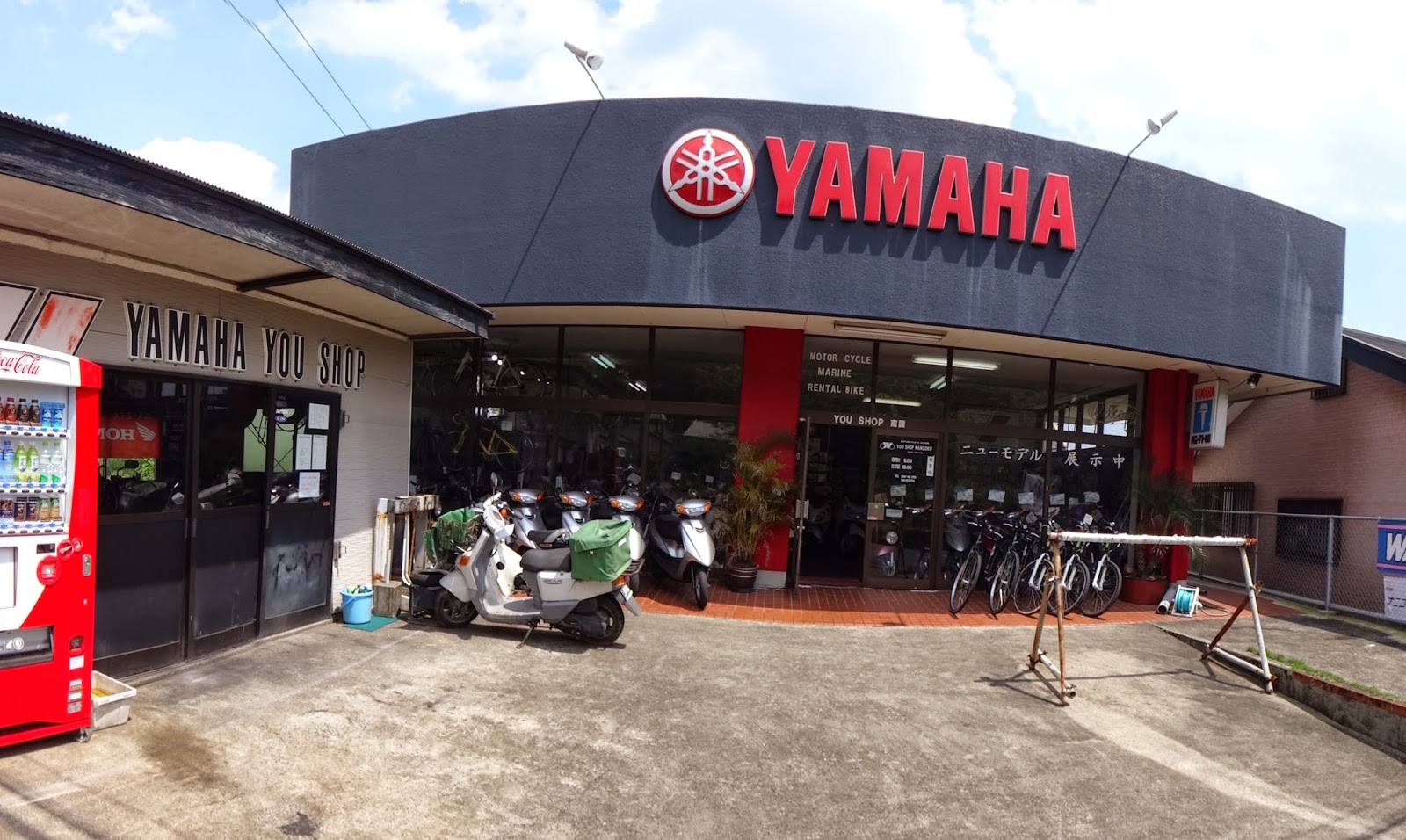
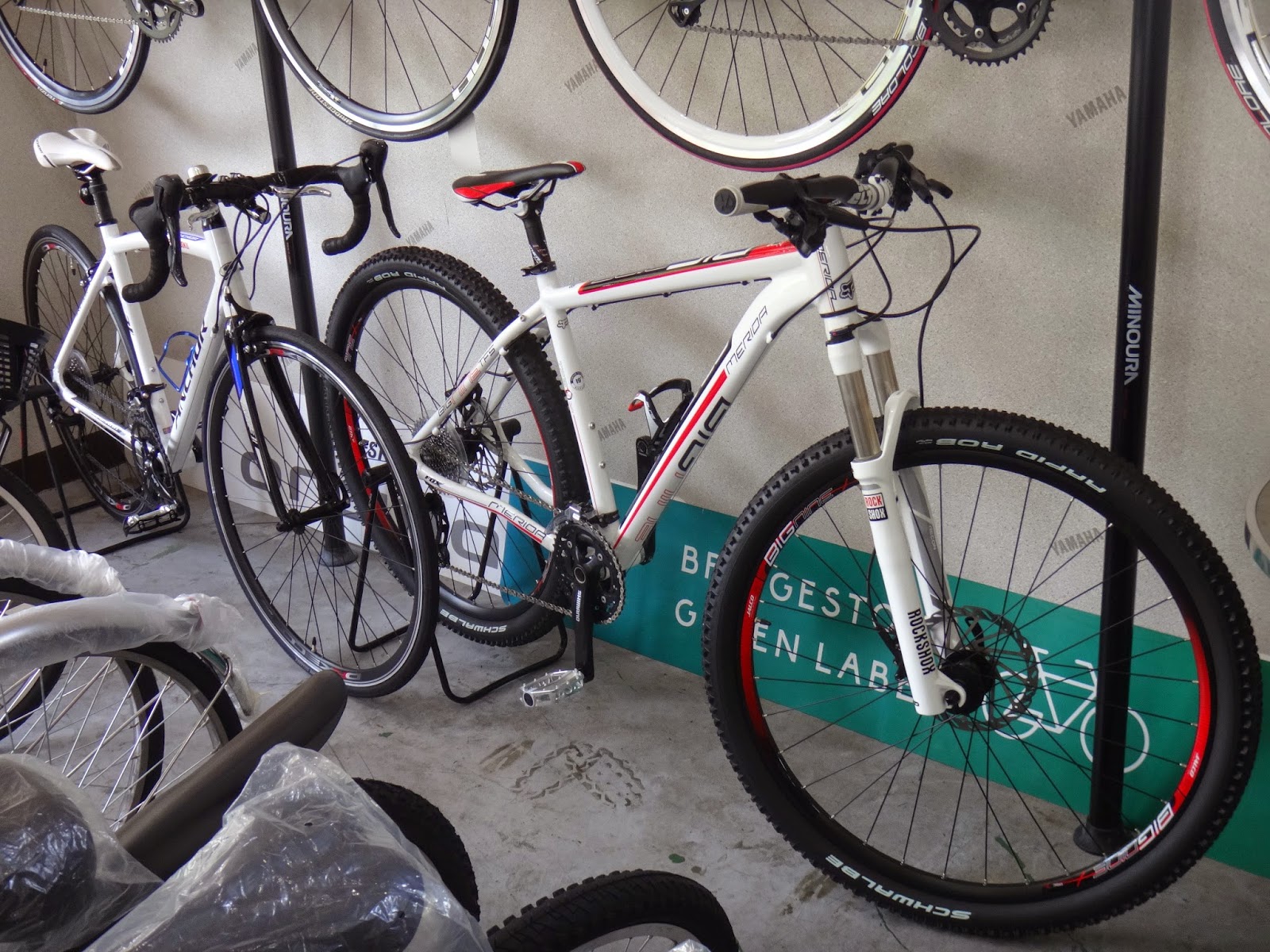
  • You Shop: If you are a serious cyclist, you'll enjoy a trip to the YOU Shop in Anbo. The owner welcomes foreigners, and you can rent anything from 21-speed cross-bikes and mountain-bikes from 800 yen/day to road bikes for 3,000 yen/day. They have both overnight and hourly rates, and if you bring your own pedals, they'll even install them for you.
    The You Shop offers both mid-range cycles (middle) and high-end cycles (right).


    The You Shop is open daily from 9am to 6pm and rents helmets and rain gear to customers who are renting bikes.

  • Midori no Kaze (formerly Mori) Rental Cycles are basic multi-speed bicycles that can be picked up and dropped off at different locations around the island for 800~1050 yen per day depending on the quality of the bike. Pickup/dropoff points open between 6:30 & 9:00am and close between 5:00 & 7:00pm. If you keep a bicycle past closing time, you will be charged for two days. 

  • In clockwise order beginning in Nagata, cycles can be picked up and dropped off in the towns of

    • Nagata, at the Marusou Gasoline Stand,
    • Issou, at the Higo Gasoline Stand (closed on Sundays),
    • Miyanoura, at Uchida Gasoline Stand
      or the Yakushima Kankou Center (30.430,130.5689, NOT the Tourist Information Booth. The Kankou Center also offers cross bikes which must be returned to the same location),
    • Koseda, at the Nanpou Gasoline Stand,
    • Anbo, at the Midori no Kirameki (Mori no Hidamari) Gift Shop,
    • Mugio, at the Botanical Research Park,
    • Onoaida, at the Hidaka Gasoline Stand (Closed on Sundays),and
    • Kurio, at the S-Mart convenience store,

    UNFORUTNATELY, MOST RENTAL LOCATIONS HAVE BEEN CUT AS OF SUMMER 2016.  as well as at a few other locations. Check for the latest locations and call first or make a reservation to make sure that a bicycle will be available for you, especially if you plan to pick one up from a smaller location.
      Please note that insurance is not included with these bicycles, and you are liable for up to 15000 in damages. These bicycles are meant to handle loads up to 85 kg. If you don't have your rental receipt when you return the bicycle you will be charged an extra 500 yen.
  • Yakushima Kankou Center: As an extension of the Midori no Kaze bicycle rentals, the Yakushima Kankou Center in Miyanoura also a high-quality tear (green bicycles in the righthand photo) for 1500 yen/day, but they must be returned to the Yakushima Kankou Center.
  • Accomodations with bicycles: Quite a few accommodations offer free or charged rental cycles of varying quality. For example, the Portside Youth Hostel in Miyanoura allows guests use of a bicycle for up to a half hour, and Tashiro Annex (also in Miyanoura) and Iwasaki Hotel (Onoaida) even have motor-assist bicycles available for rent. Some accommodations are even part of the Midori no Kaze system.
    Bringing your own bicycle
    Shipping your bicycle from Tokyo to Kagoshima costs around 30000 yen, and you can't do it (as far as I know) from the airport. However, I have seen folks assembling bicycles outside the airport in Yakushima. You cyclists never cease to amaze me!

    If you're doing a bicycle tour of Japan, then come by ferry (Yakushima Ferry 2), and you can bring your bicycle aboard for an extra 900 yen each way at time of writing. (You'll need to be at the port in Kagoshima before 7am, and during Japanese holidays, you'll need a reservation. Every so often, the ferry is also docked for routine inspection, so you'll want to check before you make your plans.) You can also take your bicycle if you are stopping by the flatter neighboring island of Tanegashima, in which case you can use the Ferry Hibiscus.

    Hazards
    Wherever you go, you may have to contend with rain, and even though the speed limit is between 30 and 50 kph almost everywhere, the roads are narrow and often do not have a shoulder. You'll have to contend with rental cars and skilled-but-brazen bus drivers along with the regular traffic. And, of course Yakushima is hilly. Please check the breaks when choosing a rental cycle (Front and rear breaks may be backwards of what you are used to.) and remember to use front and rear lights at night.


    *Hours, prices, and locations are subject to change, so please check with respective businesses when you make your plans.

    Wednesday, February 25, 2015

    Swimming Beaches

    Okay, February is not the ideal month for a dip in the ocean in Yakushima unless you're either looking for a polar-bear experience or wearing an insulated wet-suit. But today I thought I'd try to warm up by thinking about one of Yakushima's great summer activities: Swimming.

    First things first, Yakushima isn't some sandy atoll caressed by gentle tides. The shoreline is mostly rocky and there are some powerful currents in the area. In fact, the island slopes down under the sea so steeply that even marine biologists are amazed that Yakushima can support rich coral reefs, but that doesn't have to spoil your fun: There are three designated swimming beaches in Yakushima where you can splash around in relative safety: On the east coast, there is Haruta Hama in Anbo; on the West Coast there is the sea turtle beach in Kurio; and on the north coast there is the swimming beach in Isso.

    Of course, you can enjoy the beaches year round, but during summer vacation days from mid July through the end of August, showers, restrooms, and lifeguards may be found. I believe Kurio's restrooms are open all the time, but you may want a flash light.

    Isso

    Isso is probably the most lively, offering a roped-off swimming area and a beautiful sandy beach that slopes gently into the ocean. During summer vacation, venders hawk food and snorkel sets on your way from the parking lot, and there are often a few kids trying to kick a soccer ball along the sloping beach. But don't worry: The swimming area is big (and deep) enough that you can easily swim away from the bustle if that's not your style. Perfect after a morning of hiking in Shiratani! Also, if you're in to snorkeling, ask around: The bay on the other side of Yahazu Peninsula -- just a few minutes drive east of the swimming area -- is known for sea life, and -- unlike most coral reefs around Yakushima -- there are not too many big reef rocks to crash into.
    A handful of sea glass from the swimming beach in Isso.


    Haruta Hama
    The swimming hole at Haruta Hama is literally just that: A large pool carved out of the coral rock, with great protection from the waves. The swimming area is plenty big enough to swim laps, and there are two large rock piles kids like to jump off of in the middle. You can also see colorful fish lurking in shade of the rocky walls. The bottom is mostly sand, but during extreme low tides it can be a bit too shallow and salty for a pleasant swim. Bring your shoes so when you're worn out from swimming you can take a stroll along the coastal flats and peer into the tide pools.
    I love strolling the expanse of coastal flatlands near Haruta Hama.

    Kurio

    I have to admit I have never swum at the swimming beach in Kurio because I'd rather explore the nearby coral reefs of Cape Tsusaki that are so beautiful. However, because of currents and rocks, the swimming beach is a safer option if you're looking to relax or take the kids for a swim. It's protected by the same sea walls that protect the neighboring harbor, and the sand beach is usually quiet except for the lull of waves and the occassional fishing boat. Not too many swimmers venture out to this beach, although it is very popular with sea turtles during summer nights.
    Reefs and tide pools at low tide at Cape Tsusaki near Kurio. The tides can be rough, so please play it safe.

    I'm not going to state the obvious guidelines like don't swim by yourself, and don't swim after drinking alcohol, etc, but I do want to point out two important rules.

    1.) Let the sea turtles be. Remember that they bury they're eggs in the sand at night, so don't bother them by going swimming at night, and try not to disturb their nests. And, of course, no fires.

    2.) Be aware of dangerous animals. The swimming beaches listed here are safer than outer reefs, but to be on the safe side, don't touch or bother sea snakes, lionfish, striped eel catfish, cone shells (yes, sea shells can kill people), sea urchins, certain corals、fireworms (think underwater caterpillars), stonefish, blue-ringed octopuses, or man-of-war. Actually, you'd better find alternative plans if you've run into a mass of men-of-war. The animals listed here aren't known to attack, but some of them can kill you. (Hope to have a new post on these guys soon! In the meantime, I found this page featuring photos of many of these critters. ) Let's avoid touching anything we are unsure of!